Finding a pair of jeans that fits seamlessly feels like finding a needle in a haystack. You grab a size 28 in one store, only to discover that a size 28 at another boutique won't zip past your thighs. Between vanity sizing, international size discrepancies, low-rise versus high-rise rises, and fabric blend variations, buying jeans has become one of the most frustrating shopping experiences in modern retail.
An ill-fitting pair of jeans isn't just uncomfortable—it wastes your money and destroys your daily confidence.
This comprehensive guide takes the guesswork out of denim shopping. Whether you are navigating international conversion charts (US, UK, EU, JP), measuring your body with surgical precision, or adjusting for denim elasticity and rise, this ultimate guide ensures you get your ideal fit on the very first try.
1. Decoding Denim Sizing: How Jeans Sizes Work
Before diving into international conversion charts, it is essential to understand the underlying mechanics of denim sizing. Unlike standard apparel sizing (which uses small, medium, and large), denim measurement traditionally relies on precise anatomical proportions.
+-------------------------------------------------------+
| KEY DENIM MEASUREMENTS |
+-------------------------------------------------------+
| |
| WAIST (W) ---> Narrowest part of torso |
| (or where band sits) |
| |
| HIPS (H) ---> Fullest part of buttocks/hips |
| |
| INSEAM (L) ---> Croch seam to bottom ankle |
| |
| RISE ---> Crotch seam to top waistband |
| (High, Mid, or Low) |
| |
+-------------------------------------------------------+
Waist vs. Hip Measurement
Denim sizes are primarily based on two core measurements: Waist (W) and Inseam Length (L).
- Waist Size: In classic sizing, a jean labeled "28" theoretically corresponds to a 28-inch waist circumference. However, because women’s bodies curve significantly at the hips, high-end denim makers focus heavily on the hip-to-waist ratio.
- Hip Size: The hip measurement measures the fullest part of your seat. If your hips are wider relative to your waist, you will often need to size up to accommodate your hips and tailor the waist.
The Rise Factor: High, Mid, and Low
Where your jeans sit on your torso drastically alters which size you should buy:
- High-Rise (10–12+ inches): Sits at or above your natural belly button. Measure your waist at its narrowest point.
- Mid-Rise (8–9 inches): Sits between your navel and hip bones. Measure approximately 1 to 2 inches below your natural waistline.
- Low-Rise (7–8 inches or lower): Sits directly on your hips. Measure around the top of your hip bones.
Key Takeaway: Never rely on waist size alone. Always account for rise height and hip circumference, as a size 28 in high-rise denim will fit differently than a size 28 in low-rise denim.
2. Universal Jeans Size Conversion Charts
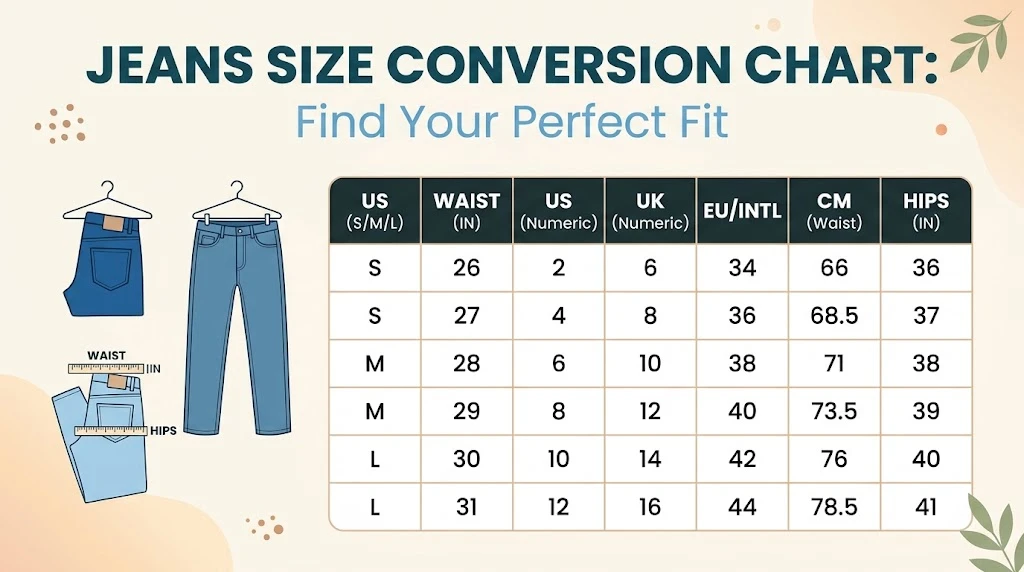
Use the standard reference tables below to convert your waist measurements, US numerical sizes, UK/AU sizes, European standards, and Japanese sizing across both Women's and Men's categories.
Women's Jeans Size Conversion Chart
| Waist (Inches)Waist (cm)US Alpha / NumericUK / AU SizeEU StandardJapan (JP) |
| 24" | 61 cm | XS / 0 | 4 | 32 | 5 |
| 25" | 63.5 cm | XS / 2 | 6 | 34 | 7 |
| 26" | 66 cm | S / 4 | 8 | 36 | 9 |
| 27" | 68.5 cm | S / 6 | 10 | 38 | 11 |
| 28" | 71 cm | M / 8 | 12 | 40 | 13 |
| 29" | 73.5 cm | M / 10 | 14 | 42 | 15 |
| 30" | 76 cm | L / 12 | 16 | 44 | 17 |
| 31" | 78.5 cm | L / 14 | 18 | 46 | 19 |
| 32" | 81 cm | XL / 16 | 20 | 48 | 21 |
| 33" | 84 cm | XL / 18 | 22 | 50 | 23 |
| 34" | 86.5 cm | XXL / 20 | 24 | 52 | 25 |
Men's Jeans Size Conversion Chart
| Waist (Inches)Waist (cm)US / UK NumericEU StandardItalian (IT)International |
| 28" | 71 cm | 28 | 44 | 44 | XS |
| 30" | 76 cm | 30 | 46 | 46 | S |
| 32" | 81 cm | 32 | 48 | 48 | M |
| 34" | 86.5 cm | 34 | 50 | 50 | L |
| 36" | 91.5 cm | 36 | 52 | 52 | XL |
| 38" | 96.5 cm | 38 | 54 | 54 | XXL |
| 40" | 101.5 cm | 40 | 56 | 56 | 3XL |
| 42" | 106.5 cm | 42 | 58 | 58 | 4XL |
Pro Tip: European sizing for women typically runs smaller than US vanity sizing. If converting from a US size to an EU size (e.g., US 6 to EU 38), double-check the brand's specific hip measurements, as European cuts often feature narrower hips.
3. How to Measure Yourself for Jeans Step-by-Step
Precision is key to avoiding return shipping hassles. Grab a soft, flexible cloth tape measure and follow this 4-step framework.
+-------------------------------------------------------+
| 4-STEP MEASUREMENT GUIDE |
+-------------------------------------------------------+
| |
| 1. NATURAL WAIST --> Measure narrowest torso point |
| 2. FULL HIPS --> Measure widest seat area |
| 3. INSEAM LENGTH --> Inner crotch to ankle bone |
| 4. THIGH WIDTH --> Widest upper thigh point |
| |
+-------------------------------------------------------+
Step 1: Measure Your Waist
Stand up straight with your feet flat on the floor. Exhale naturally (do not suck in your stomach). Wrap the soft tape around your natural waistline, which is located midway between your lowest rib and the top of your hip bone (usually right above your belly button). Keep the tape parallel to the floor and snug, but not digging into your skin.
Step 2: Measure Your Hips
Stand with your feet together. Locate the fullest point of your hips and buttocks. Wrap the tape measure smoothly around this area, making sure the tape remains level around your backside.
Step 3: Measure Your Inseam
The inseam determines length. Take an existing pair of well-fitting jeans, lay them flat on a hard surface, and measure along the inside leg seam from the crotch point down to the bottom hem.
- Ankle Length: 26–28 inches
- Regular Length: 30–32 inches
- Tall/Long Length: 34–36 inches
Step 4: Measure Your Thigh Width
If you have an athletic build or hourglass shape, thigh clearance is critical. Measure around the thickest part of your thigh, just below the crotch.
Example Scenario: Sarah measures a 27.5-inch waist and 38-inch hips. Because 27.5 sits between sizes 27 and 28, she checks the fabric blend. For 100% rigid cotton, she orders a size 28 to give her hips space. For a stretch blend (2% elastane), she opts for a size 27.
4. Understanding Fabric Elastane and Stretch Levels
Fabric composition dictates how jeans fit over time. Two pairs of jeans with identical waist tags will fit completely differently depending on their elastane or spandex content.
+------------------+-----------------------+----------------------------------+
| Fabric Type | Composition | Sizing Recommendation |
+------------------+-----------------------+----------------------------------+
| Rigid Denim | 100% Cotton | True-to-size or Size UP 1 size |
| Comfort Stretch | 98-99% Cotton, 1-2% | True-to-size (Will conform) |
| | Elastane/Spandex | |
| Super Stretch | 90-95% Cotton, 5-10% | Consider sizing DOWN 1 size |
| | Synthetic Stretch | |
+------------------+-----------------------+----------------------------------+
100% Rigid Cotton
- Characteristics: Classic vintage feel, zero stretch, structured silhouette.
- Fit Behavior: Tight at first, will break in slightly over months of wear, but will not expand significantly at the waistband.
- Sizing Rule: Buy true to size or size up if you are between sizes.
Comfort Stretch (1% to 2% Elastane / Spandex)
- Characteristics: Traditional denim aesthetic with subtle flexibility.
- Fit Behavior: Holds shape while offering flexibility for sitting and moving.
- Sizing Rule: Order your exact true size.
Super Stretch / Jegging Blends (3%+ Elastane or Polyester Mixes)
- Characteristics: Highly flexible, soft, figure-hugging.
- Fit Behavior: Prone to stretching out after continuous wear during the day.
- Sizing Rule: Size down if you are between sizes; otherwise, the waistband may slip down over time.
5. Navigating Brand-Specific Fit Variations
Not all brands measure a size 28 the same way due to vanity sizing—a practice where brands label clothes with smaller sizes than their actual physical dimensions to make shoppers feel better.
Brand Profiles: High Street vs. Designer Denim
- Levi’s: Classic, consistent sizing. Levi’s 501s (rigid) run true to size but fit snug in the hips. Levi's stretch lines offer standard vanity sizing.
- Zara & Mango: European sizing tendency. These cuts generally run slim through the thighs and hips compared to American brands.
- Madewell: Known for generous vanity sizing. You will often need to size down 1 to 2 sizes from your standard measurement.
- Frame, Mother, & AG Jeans: Premium designer brands that cut true to size, focusing heavily on tailored hip-to-waist ratios.
6. Common Denim Sizing Pitfalls & How to Avoid Them
Even with sizing charts, shoppers frequently fall into common traps. Here is how to avoid them:
Pitfall 1: Ignoring the "Rise" When Buying Online
- The Error: Buying a size 28 low-rise jean based on your natural waist measurement (28 inches).
- The Fix: Always measure the specific area of your torso where the rise of the jean will actually rest. Low-rise jeans sit on the hips, which are almost always wider than the natural waist.
Pitfall 2: Trying Jeans On While Standing Only
- The Error: Trying on rigid jeans, standing in front of a mirror, and assuming they fit because they look great.
- The Fix: Perform the "Sit and Crouch Test." Sit in a chair or squat down. If the waistband cuts painfully into your stomach or pulls down excessively at the back, you need to size up or adjust your rise choice.
Pitfall 3: Washing Stretch Denim in Hot Water
- The Error: Shrinking stretch jeans by tossing them in a hot wash and hot dryer cycle.
- The Fix: Heat breaks down elastane synthetic fibers. Washing stretch denim in hot water causes the fibers to snap, resulting in sagging, baggy knees, and ruined elasticity. Wash cold and air dry.
7. Frequently Asked Questions (FAQ)
How do I know my jeans size without a tape measure?
You can use the string-and-ruler method. Wrap a non-stretchy piece of string or ribbon around your waist where your pants sit, mark where the end meets, and lay the string flat against a flat ruler or construction tape. Alternatively, take a pair of pants that fit perfectly, lay them flat, measure straight across the waistband, and double that number.
Should jeans be tight or loose when you first buy them?
100% rigid cotton jeans should feel snug when brand new—almost slightly tight across the hips and seat—because cotton fibers relax and stretch out about half a size with wear. However, stretch denim should fit comfortably right away without pinching.
What does "W" and "L" stand for in jean sizes?
"W" stands for Waist width in inches (e.g., W28), and "L" stands for Inseam Length in inches (e.g., L32). A jean tagged W30/L32 has a 30-inch waist circumference and a 32-inch inner leg seam length.
Why do I fit a size 28 in one brand and a size 30 in another?
This is due to vanity sizing, pattern drafting variations, and brand geography. American retail brands tend to use larger dimensions for a given size number than European or Asian brands. Fabric elasticity also influences how a brand designs its baseline sizing patterns.
Conclusion: Step Into Your Ideal Fit
Mastering jeans sizing comes down to three basic steps: knowing your true anatomical measurements, understanding how fabric elasticity behaves, and referencing brand-specific conversion charts. By focusing on your waist-to-hip ratio and checking rise measurements, you can comfortably order jeans online without worrying about return shipping labels.
Ready to upgrade your wardrobe with jeans that fit like a glove?
Take Action Today: Grab a flexible tape measure, log your exact waist, hip, and inseam numbers into your phone notes, and use the conversion charts above to find your true denim size!
 english


 Automotive
 Gifts & Occasions
 Electronics & Computers
 Fashion & Apparel
 Beauty & Personal Care
 Home & Lifestyle
 Sports & Fitness
 Books, Movies & Music
 Baby & Kids